
Re.Pack 5: Mobile Microfrontends, 5x Faster, Less Configuration
Authors


We are thrilled to announce the release of Re.Pack 5, our biggest update ever. This milestone release represents a complete transformation of our build tool for React Native applications, bringing unprecedented performance improvements through Rspack, proper microfrontends support through Module Federation 2, simplified configuration and more!
Rspack – 5x faster than webpack
One of the most exciting features in Re.Pack 5 is the introduction of first-class support for Rspack, a blazing-fast Rust-based bundler that's highly API-compatible with webpack. This integration brings dramatic performance improvements to your React Native development with Re.Pack:
- Faster cold builds: Rspack can be up to 5x faster than webpack for both development and production builds;
- Faster refreshes: Hot Module Replacement is up to 5x faster with Rspack than with webpack;
- Webpack compatible: Rspack maintains API compatibility with webpack, so migration is easy.

Rspack's own benchmark showing 3-20x improvement for web projects compared to Webpack. For React Native and Re.Pack it's consistently 5x faster across the board
Most projects can switch with minimal changes to their configuration files. We've carefully tuned our Rspack integration to work with React Native's specific requirements, ensuring you get all the performance benefits without compatibility issues.
While Rspack brings exciting performance benefits, Re.Pack 5 continues to fully support webpack. This dual-bundler approach lets you migrate at your own pace and maintain compatibility with your existing webpack plugins and workflows.
We highly recommend you give Rspack a try - we can't imagine going back ourselves.
True Mobile Microfrontends with Module Federation 2
Module Federation 2 is literally a game-changer for Re.Pack, making it significantly easier to build and manage microfrontends in React Native, without the need to resort to special APIs like Federated. Previously, integrating Module Federation required complex workarounds, cumbersome configuration, and a subpar developer experience. With the latest improvements in Module Federation 2, Re.Pack can now tap directly into the loading process, aligning it well with React Native's runtime requirements.
The biggest win? Importing federated modules now works just like on the web. Re.Pack 5 uses dynamic imports so the Federation Runtime handles all the complexity behind the scenes. Your modules load at runtime with zero extra boilerplate.
Before
const Dashboard = React.lazy(() =>
  Federated.importModule('dashboard', './App'),
);
After
const Dashboard = React.lazy(() => import('dashboard/App'));Module Federation 2 brings major improvements to hot module replacement (HMR) between federated apps. Previously, HMR would break when crossing federated boundaries, forcing you to manually refresh or restart the app. Now, module updates work reliably across federated apps, so you can focus on development instead of such annoyances.
Deployments
While Module Federation 2 makes building mobile microfrontends easier, managing and deploying them at scale still presents challenges. That's why we're excited about our collaboration with Zephyr Cloud, which provides first-class support for Module Federation. Zephyr Cloud is helping to simplify the deployment and management of federated applications, ensuring that teams can scale their architectures without the operational headaches and run it on their own cloud.
Re.Pack 5 and Zephyr Cloud make building and maintaining modular React Native apps actually practical for real-world teams. Be sure to check out the official example of the integration between the two as well as the official documentation of the platform.
Smaller Configuration
In previous versions of Re.Pack, just as you'd expect from a webpack-driven project, configuration files were very long and verbose even in the most basic apps. Our template included many options that would often remain unchanged no matter the specific project requirements. We noticed this in the issues too—most of them looked exactly the same and they were clouding the parts that mattered. This was a very different approach in contrast to Metro, which hides all the defaults from you and starts with a minimal configuration that's only 11 lines long (as of React Native 0.78).
In Re.Pack 5, we wanted to make configuration more friendly, especially to the new users. We've picked the right defaults, added some additional helper functions and voila! We've made the configs 140 lines shorter by default, so it fits in 16 lines.
There's one more thing that's new above—we've made it possible to use Re.Pack with static configurations (where configuration isn't a function with env as a first argument). This type of configuration is something you usually come across when dealing with Rspack or webpack, and we didn't want to enforce the dynamic configuration format on users anymore.
Refresh of init command
We've reworked the way you get started with Re.Pack. Previously, the init command was only used to migrate the project from the standard template to one using Re.Pack.
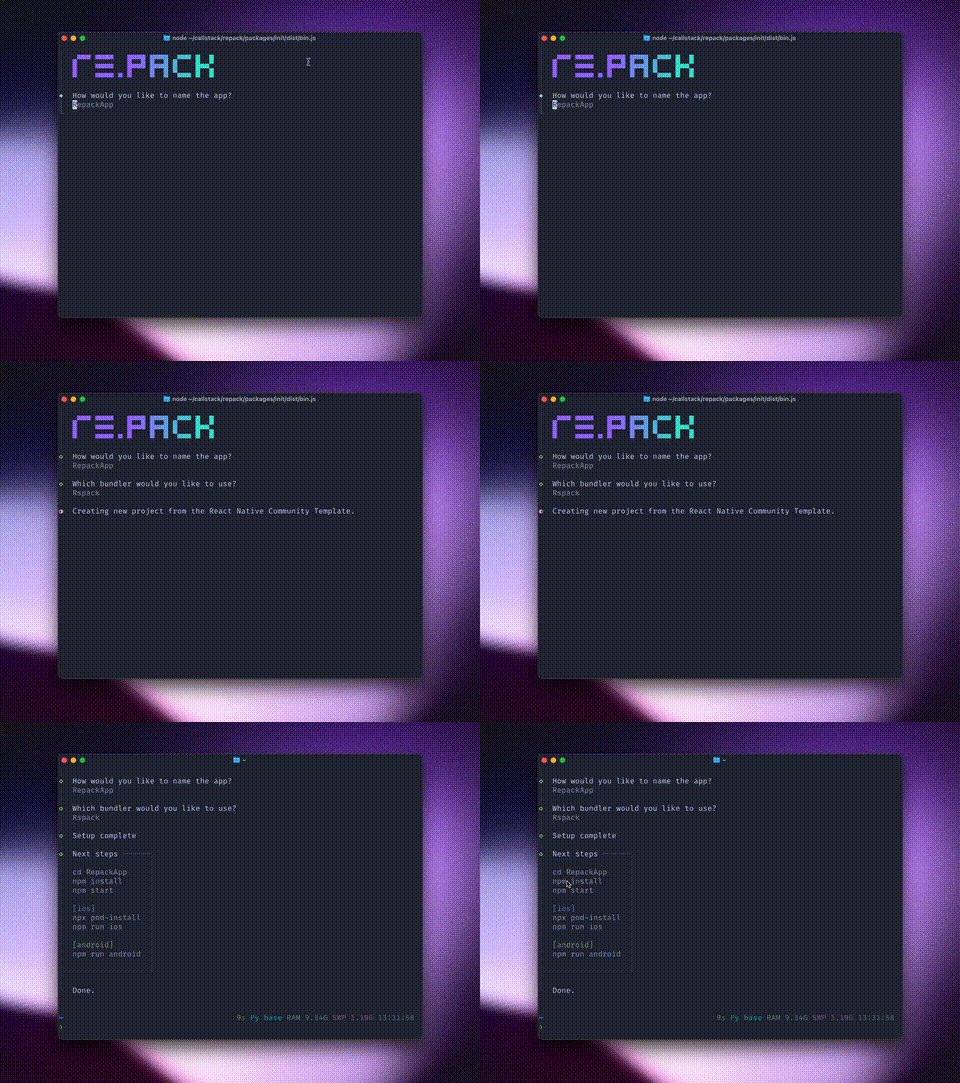
The init command now comes with a fresh new look and is able to initialize a new React Native project from scratch. It uses @react-native-community/cli under the hood which creates a project from the official template and then modifies the project to use Re.Pack.
You can use it the same way as before:
npx @callstack/repack-init@latest
Shoutout to Jack Herrington for pushing us to improve this experience for all newcomers!
Drop-in replacement for Metro
Re.Pack is aiming to replace Metro with minimal friction. We're constantly working to make switching between the two as smooth as possible.
In version 4, we made module resolution fully compatible with the React Native ecosystem, making it easier to adopt Re.Pack in existing projects. For version 5, we focused on ensuring that the SWC transformation profile—now used instead of Babel when using Rspack—is fully compatible with the official @react-native/babel-preset. This means that in the vast majority of cases, you should not expect any sort of transpilation issues when using Re.Pack rather than Metro.
To bridge the gap even further, Re.Pack 5 also introduces three dedicated plugins for popular libraries loved by the React Native community:
These plugins take care of integration with Re.Pack, abstracting away the complexities of the webpack ecosystem & making it possible to use these libraries in projects without too much hassle.
Shoutout to Zephyr Cloud for sponsoring the work on NativeWind integration!
Migrating from Re.Pack 4 & webpack
To deliver these substantial improvements, we had to introduce some breaking changes to the API and configuration system. While this means you'll need to update your existing projects, we promise these changes are for the better and remove more code than they add. They've allowed us to create a more intuitive and consistent developer experience.
To help you with the process, we've prepared comprehensive migration guides. The effort to upgrade will be quickly rewarded with faster builds (if you adopt Rspack), cleaner configurations, and access to cutting-edge features that weren't possible before.
- Migrating from Re.Pack 4 guide for when you're already using Re.Pack
- Migrating from webpack to Rspack to speed up your builds through Rspack
You can read the full release notes here.
Future of Re.Pack
The future of Re.Pack looks brighter than ever. We're here to reassure you that this project will continue to be actively maintained by Callstack.
With a dedicated core team of two members - Jakub Romańczyk and Szymon Rybczak, who recently joined the team—we're committed to pushing the boundaries of what you can build with Re.Pack.
To give you a sneak peek, here's what we plan for the 5.1 release:
- Focus on creating a dedicated way for facilitating Over-the-Air (OTA) updates for MiniApps while preserving proper native user experience.
- Add support for Rsbuild, which takes a much more modern approach to configuration while still maintaining compatibility with Rspack.


